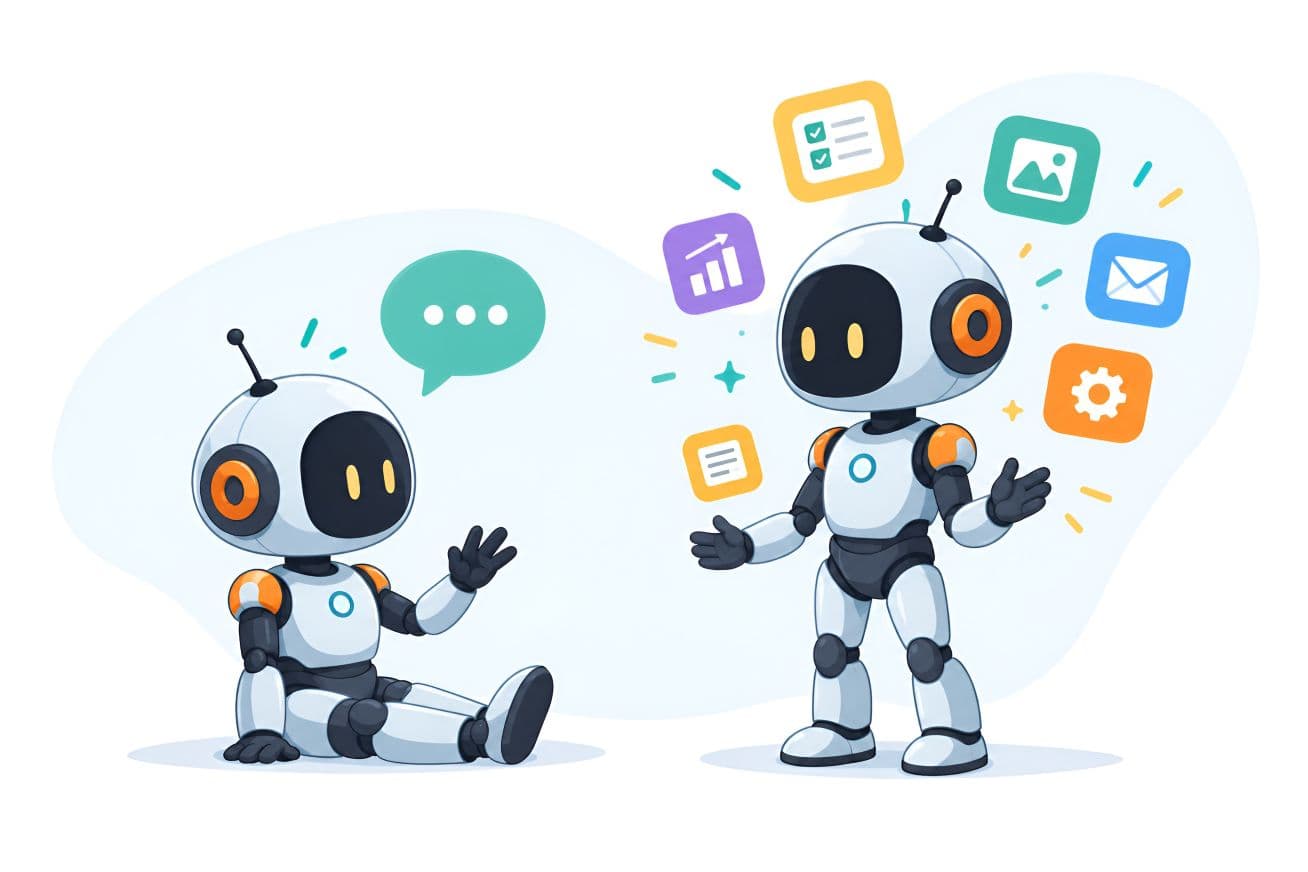
Ever typed a question into a website chat box and got an instant reply? That’s a chatbot. Now imagine the same chat box working out which service you need, checking a calendar and booking your meeting, with nobody on the team lifting a finger. That’s an AI agent.
This guide explains the difference in plain English, shows how AI agents work, and gives you a simple way to start with business automation.
THE SHORT ANSWER
A chatbot understands what you ask and replies. An AI agent understands what you want, plans the steps, uses connected tools and gets the job done. The difference is what happens next.
What’s the real difference between a chatbot and an AI agent?
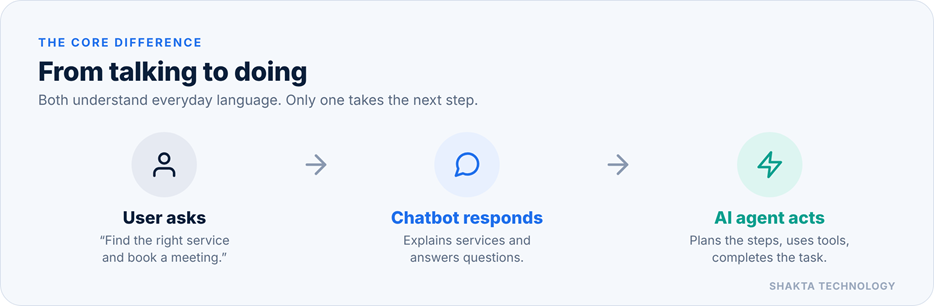
A common mix-up: people think an AI chatbot can’t understand normal language and an AI agent can. Not true. Modern chatbots handle everyday wording well. The real difference is what happens after the system understands you.
A chatbot understands and responds. Ask “Do you build websites?” and it tells you. An AI agent works toward a goal. Say “Find the right service for my shop and book a meeting” and it works out the steps, uses connected tools and carries them out.
Think of a chatbot as a friendly receptionist, and an AI agent as an assistant who also handles the paperwork.
What is an AI agent and how does it work?
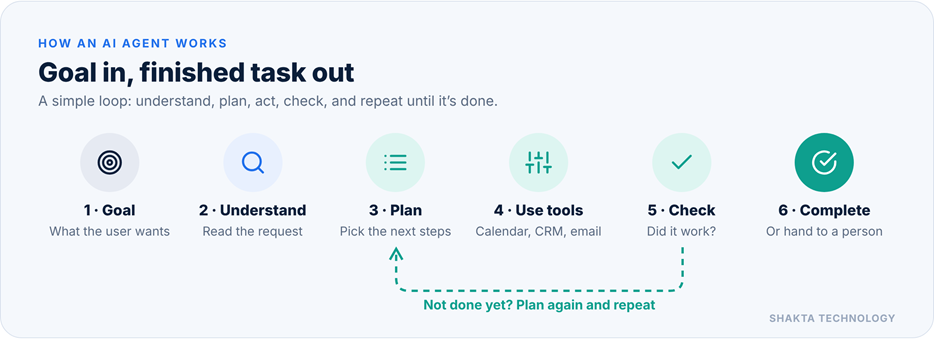
An AI agent is software that works toward a goal. It figures out what needs to happen, uses the tools it’s connected to, checks the result and hands over to a person when needed. Most agents follow the same loop:
1. Understand the goal.
2. Plan the next steps.
3. Use tools like a calendar, CRM or email.
4. Check the result, and adjust if needed.
5. Finish the task or hand over to a person.
What an agent can do depends on how it’s built, which systems it can reach and what permissions it has. It’s only as capable, and as safe, as its setup.
Chatbot vs. AI agent: a side-by-side comparison
| Chatbot | AI agent |
Main role | Understands requests and responds | Works toward a goal and can take actions |
Interaction | Natural conversation | Conversation plus actions |
Workflow | Follows conversational flows | Plans multiple steps |
Tools | Limited integrations | Connects to tools and business systems |
Example | “Do you provide website development?” → Answers the question | “Find the right service and book a meeting.” → Can complete the next steps |
What can AI agents do for a business?
AI agents for business work best where tasks are repetitive, span several systems or take multiple steps. Depending on the setup, they can:
• Answer questions and collect details for the next step.
• Qualify leads before they reach your sales team.
• Schedule meetings through a connected calendar.
• Send follow-up messages after a customer interaction.
• Summarise documents, tickets and conversations.
• Move approved information between business systems.
• Take care of repetitive admin work for your employees.
What does AI automation look like in everyday work?
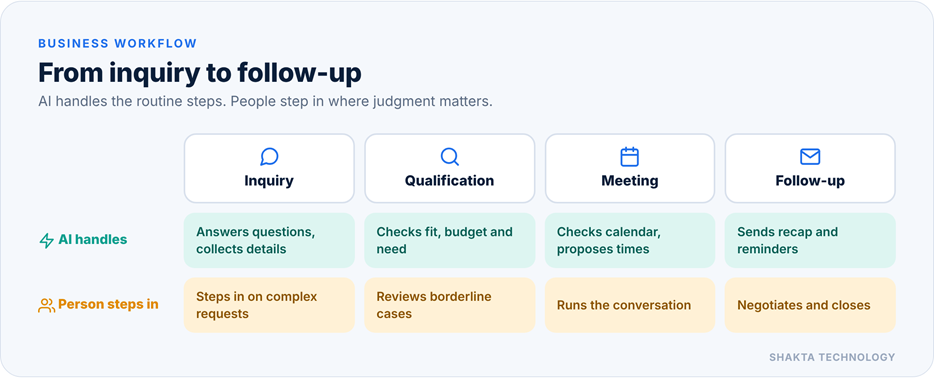
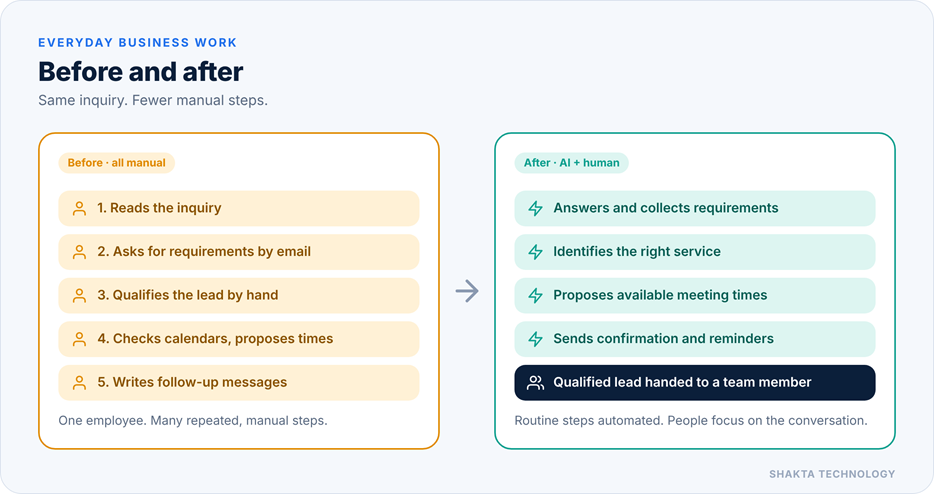
Picture a company getting dozens of website inquiries a day. A chatbot answers each visitor’s questions. An AI agent goes further: it collects requirements, matches the right service, checks free meeting times and prepares everything for a team member.
The goal isn’t to make AI do everything. It’s to remove manual steps so people can focus on work that needs judgment. The payoff is faster responses, less repetitive work and more consistent follow-up.
Why are businesses paying attention to AI agents?
For most businesses, it isn’t about adding yet another AI tool. It’s about improving the workflows that already eat up time, like answering the same questions, copying information between systems and chasing leads. The benefits businesses look for:
• Faster responses to customers and leads.
• More consistent follow-up, so nothing slips through.
• More time for higher-value work that people do best.
Will AI agents replace employees?
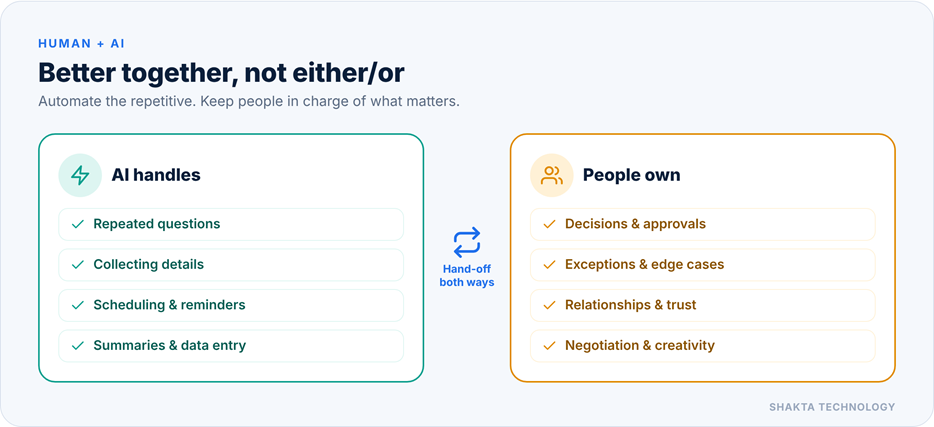
Not necessarily. AI agents work best as workflow assistants for repetitive, structured tasks, while people stay essential for judgment, creativity, relationships and complex decisions. The better question isn’t “Can AI replace this person?” but “Which parts of this workflow should be automated, and where should a human stay in control?”
How can AI agents change the way websites work?
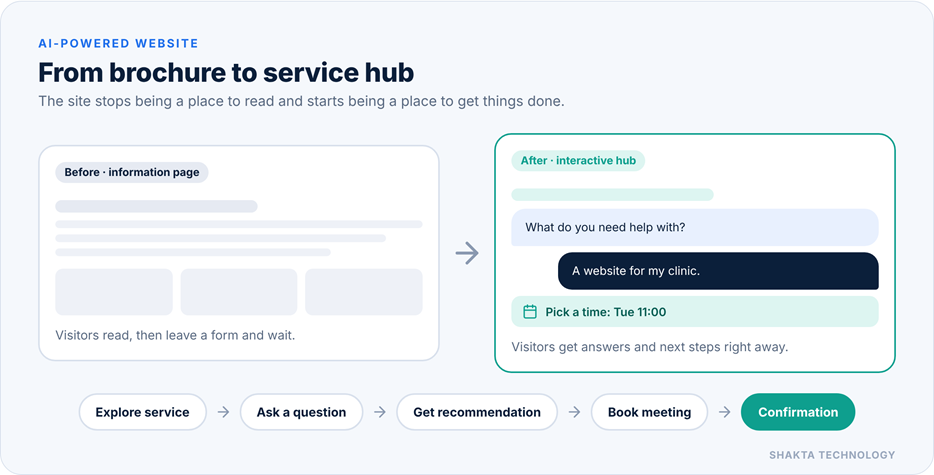
A website doesn’t have to be only a place to read. An AI-powered website can help visitors find the right service, answer their questions, collect requirements or start a meeting request. That doesn’t mean every business needs one. A fast, clear website still comes first, and AI should solve a real problem, not be added because it’s trending.
How can a business start using AI agents?
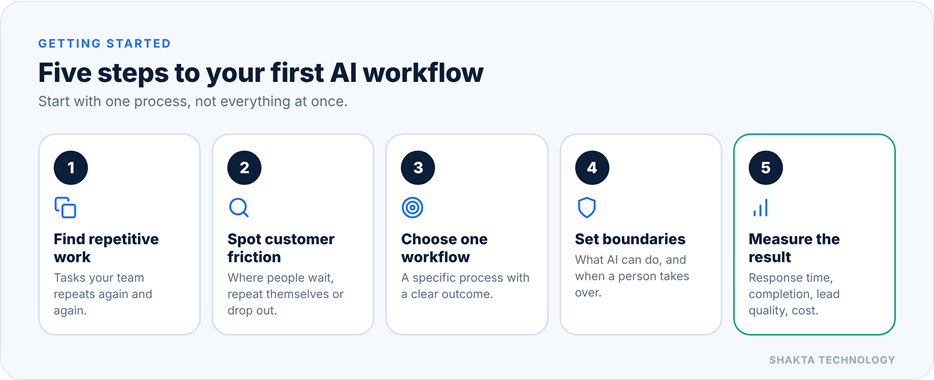
Don’t automate everything at once. Start with one clear workflow:
1. Find repetitive work your team does again and again.
2. Spot customer friction, like waiting, repeating information or dropping out.
3. Choose one workflow with a clear outcome.
4. Set boundaries: what the AI can do and when a person takes over.
5. Measure the result: response time, completion rate, lead quality or cost.
Keep it safe, too: let the agent work from approved information, be clear about what customer data it can use, and always give customers an easy way to reach a real person.
Where are AI agents heading?
Chatbots brought conversational AI to the customer experience. AI agents take the next step toward goal-driven workflows. The technology is still evolving, and not every process should be automated. But the direction is clear: AI in business is moving beyond better answers toward useful actions and better workflows.
“Chatbots gave businesses a way to talk with customers. AI agents are giving businesses a way to act.”
Frequently asked questions about AI agents
What is an AI agent?
An AI agent is software that works toward a goal. It understands a request, decides which steps are needed, uses connected tools and checks the result.
What is the difference between an AI agent and a chatbot?
A chatbot is built to converse and respond. An AI agent goes further by planning steps, using tools and carrying out actions, like booking a meeting.
Can chatbots understand normal language?
Yes. Modern AI chatbots understand everyday wording. The difference is what happens after the request is understood.
What can AI agents automate?
Depending on the setup: lead qualification, scheduling, follow-ups, information collection, summaries and other repetitive workflows.
Will AI agents replace employees?
Not necessarily. They work best as workflow assistants, while people handle judgment, relationships and complex decisions.
How do I start with AI automation in my business?
Start with one repetitive workflow that has a clear outcome, such as website inquiries. Define what the AI can do, when a person takes over, and how you will measure success.
Does every website need an AI agent?
No. A clear, fast website comes first. Add an agent only when it solves a specific customer or workflow problem.
Ready to explore what AI could automate in your business?
Start with the workflow, not the technology. Pick one repetitive task, then see if AI can make it faster and simpler.
Talk to Shakta Technology about your website development, software solutions, AI and automation and digital solutions.